Shepherd Us

Shepherd Us

The Lord is our shepherd. Let us walk in his footsteps.

مسيحيو الأرض المقدسة: باقون

Shepherd Us is a foundation established to help our Christian brothers and sisters suffering in the Holy Land, the home of Jesus. Together, we can help families remain in their homes, care for their children and live with dignity in the land where he walked.

Christian life, displacement and survival

From the first churches to the expulsions of 1948 and the pressures facing communities today. Selected events; dates are not to scale.

  1. c. 33

    Pentecost in Jerusalem. The first Christian community takes root.

  2. 339

    Church of the Nativity dedicated in Bethlehem.

  3. 638

    Patriarch Sophronius hands Jerusalem to Caliph Umar, and the churches keep operating.

  4. 1099

    Crusaders take Jerusalem and sideline the local Orthodox clergy.

  5. 1517

    Ottoman rule begins and lasts four centuries.

  6. 1948The Nakba

    Mass expulsion and flight uproot Palestinian communities, including Christians in Jerusalem, Jaffa, Haifa and numerous villages. Legal scholar Ardi Imseis describes the dispossession and prevention of refugee return as ethnic cleansing.

    Imseis · 2024 paper; McGahern · Christian communities
  7. October 1948The Eilaboun massacre

    Israeli troops kill twelve men after taking the predominantly Christian village and expel residents toward Lebanon. Many villagers are later allowed to return following international pressure.

    Una McGahern · Durham University, 2010, p. 76
  8. 1948–1953Iqrit and Kafr Bir’im

    Israeli forces expel the residents of these Christian villages in 1948. The villages are subsequently destroyed, Iqrit in 1951 and Kafr Bir’im in 1953. Displaced families continue seeking return.

    Iqrit Community Association; McGahern · village destruction
  9. 1967Occupation begins

    Israel occupies the West Bank, including East Jerusalem, and Gaza. Christian communities in Bethlehem, Jerusalem and Gaza enter a new period of military occupation.

    PCPSR · historical background
  10. 1997Har Homa at Jabal Abu Ghneim

    Israel proceeds with the settlement project between Bethlehem and East Jerusalem. Settlement expansion and restrictions on Palestinian building progressively narrow Bethlehem’s room to grow.

    UN Yearbook · 1997; Land and livelihoods
  11. 2015The barrier reaches Cremisan

    Construction resumes near Beit Jala, uprooting olive trees and separating families from farmland. Christian communities oppose the loss of access to land, churches and a local school.

    OCHA · Beit Jala; Holy Land Co-ordination
  12. 2017A declining share of the population

    The Palestinian census records 46,850 Christians in the West Bank and Gaza, about 1% of the population, compared with 1.5% in 1997. Emigration and slower population growth reshape communities.

    PCPSR · census figures and migration research
  13. October 2023Deaths at Saint Porphyrios

    An Israeli strike hits Gaza’s Orthodox church compound, where civilians are sheltering. The World Council of Churches reports eighteen dead, including nine children. The war also brings a collapse in Bethlehem’s tourism.

    WCC · October 23, 2023; Bethlehem’s economy
  14. July 2025Holy Family Church struck

    An Israeli army strike hits Gaza’s Catholic church compound. The Latin Patriarchate reports three people killed and nine wounded among a community sheltering from the war.

    Latin Patriarchate · July 17, 2025

The loss of Christian presence differs from place to place. Some villages were emptied by force; elsewhere, emigration and unequal population growth reduced the Christian share. The West Bank and Gaza census count rose from 40,055 in 1997 to 46,850 in 2017 even as that share fell. Israel’s separate 2024 statistics reported 180,300 Christians and 0.6% annual growth. These figures cover different populations and do not measure the same trend. PCPSR; Israel Central Bureau of Statistics.

سلامSalam · Arabic
ܫܠܡܐShlama · Syriac
שלוםShalom · Hebrew
εἰρήνηEirēnē · Koine Greek
PaxPeace · Latin

At home and abroad

A community scattered far from home

Many Palestinian Christian families now live far from the towns their parents and grandparents knew. Their ties to home continue through relatives, churches, language and family traditions.

The Palestinian Come & See guide describes a large majority of the community as living in the diaspora, while acknowledging that there is no comprehensive census.

Come & See, p. 17. This older estimate should not be read as a current population count.

إيمان، رجاء، محبة

Faith. Hope. Love.

Our concern is for those who remain, and for families abroad who want to keep their connection to home.

Life in the Holy Land

Why families leave

Settler violence, military operations, restrictions on movement and the loss of a living put pressure on families to leave. Local churches and humanitarian organizations describe what that means in daily life.

Settler attacks in Taybeh

In their July 14, 2025 statement, Jerusalem's church leaders reported fires set by Israeli settlers near Taybeh's cemetery and historic Church of St. George. They also described intimidation, damaged olive groves and attacks on homes.

Patriarchs and Heads of Churches · July 14, 2025

Protection and accountability

The Taybeh church statement accused Israeli authorities of enabling the settlers' presence and called for an investigation into unanswered emergency calls and a lack of accountability.

Read the church leaders' statement

Displacement is continuing

OCHA's September 18, 2026 report identifies Israeli military operations, settler violence, demolitions and movement restrictions as drivers of humanitarian need in the West Bank. It reports more than 2,600 Palestinians displaced that year in the context of settler violence and related access restrictions. This is a figure for Palestinians overall, not Christians alone.

UN OCHA · September 18, 2026

The need for work

A 2020 survey of Palestinian Christians found economic opportunity was the most frequently cited reason for wanting to emigrate. Respondents also described the effects of occupation, insecurity and shortcomings in Palestinian governance.

Palestinian Center for Policy and Survey Research · 2020

Christian and Muslim neighbors

In that survey, most Christian respondents reported no harassment from Muslim neighbors, at school or at work. A minority reported insults or discrimination. Experiences vary, and those who report discrimination should also be heard.

PCPSR survey · 2020

Citizenship without full equality

Palestinian Christians who hold Israeli citizenship can still face discrimination as members of the country’s Arab minority. They have citizenship rights, including the right to vote and stand for parliament under the same general eligibility rules as other citizens. Those rights coexist with unequal treatment. Basic Law: The Knesset, §§5–6.

The 2018 Nation-State Basic Law reserves national self-determination in Israel to the Jewish people, establishes Hebrew as the state language and gives Arabic special status. It also makes the development of Jewish settlement a national value. These distinctions concern non-Jewish citizens, including Palestinian Christians, within Israel itself. Read the law, §§1, 4 and 7.

In 2019, the UN Committee on the Elimination of Racial Discrimination expressed concern about laws discriminating against Arab citizens in legal protection, social and economic benefits, and land and property rights. Its findings concern the wider Arab population, of which Palestinian Christians are part. UN committee findings, §§13–16.

The Catholic bishops of the Holy Land warned that the Nation-State Law established a basis for discrimination and demanded equal citizenship for Christians and their fellow non-Jewish citizens. This unequal standing is what we mean by second-class treatment. Citizenship should bring equal dignity, protection and belonging, regardless of faith or ancestry. Catholic bishops’ response · November 2018.

Israeli citizenship is distinct from the permanent-residency status held by many Palestinians in East Jerusalem and from the status of Palestinians in the West Bank and Gaza. These are different legal situations.

We want Christian families to live safely alongside their Muslim and Jewish neighbors. We oppose the violence and policies that drive people from their homes, and we reject collective blame.

Residents, pilgrims and clergy

Worship without fear or humiliation

A strong, secure Christian community can help make the Holy Land more welcoming for everyone. Local parishes, schools, guides and families sustain relationships across faiths, welcome pilgrims and speak up when someone is threatened. We believe supporting that presence can help resist intimidation and reduce isolation.

Safety also requires authorities to prevent attacks, investigate them and protect freedom of worship. No one should have to accept spitting, insults or violence as the price of wearing a cross, serving a church or visiting a holy place. That standard belongs equally to Christians, Muslims and Jews.

Spitting at pilgrims and clergy

In October 2023, footage showed people spitting beside a Christian procession in Jerusalem’s Old City. Israeli police subsequently announced arrests in connection with incidents involving pilgrims and churches.

The Rossing Center’s 2024 report recorded 111 incidents against Christians in Israel and East Jerusalem, including physical harassment and damage to religious property. These reports describe a recurring problem, with consequences for how safely people can walk through their own neighborhoods.

AP · October 3, 2023; AP · arrests, October 4; Rossing Center · 2024 report

Attacked while walking in Jerusalem

On April 28, 2026, a Catholic sister was pushed to the ground from behind and kicked while walking on Mount Zion. Middle East Concern’s account, which includes her own testimony, describes an attack interrupted by a bystander. Israeli authorities arrested a suspect the following day.

The sister expressed forgiveness while insisting on justice and protection against another attack. Her experience makes the need for both public intervention and official accountability painfully concrete.

Middle East Concern · May 28, 2026

Easter behind checkpoints

For Holy Saturday on April 19, 2025, OCHA documented checkpoints around Jerusalem’s Old City and restricted access to the Church of the Holy Sepulchre. Palestinian Christians with West Bank IDs also faced limited entry permits.

The World Council of Churches reported worshippers being held at the New Gate checkpoint, pushed, beaten and subjected to derogatory remarks. Its account describes repeated barriers and people turned away. Treatment like this makes a journey to worship an experience of humiliation and uncertainty.

OCHA · April 2025; WCC · April 22, 2025

A holiday visit requires permission

For Palestinians who need Israeli travel permits, visiting Jerusalem or Christian sites inside Israel can depend on whether permission is granted. Rules vary by residence and period. In December 2019, Middle East Concern documented restrictions on Gaza Christians’ Christmas travel, contrasting them with permits for Jerusalem, Bethlehem and Nazareth the previous year.

At Easter 2023, the WCC reported the experience of a Gaza mother whose husband and children received permits for Jerusalem while she did not. Families can be separated even when some members are allowed to go. The freedom to pray at one’s holy places should be protected with dignity.

Middle East Concern · December 16, 2019; WCC · Easter 2023

Who they are

Christianity began in this land. Palestinian Christians belong to its long history, with communities in Bethlehem, Beit Jala, Beit Sahour, Ramallah, Taybeh and Gaza. Christian life also continues in Nazareth, Haifa and the Galilee, and among Jerusalem’s Armenian and Syriac communities.

“Arab” is a broad identity rooted in language and culture. It does not imply a single ancestry or religion. Across North Africa, the Levant, Mesopotamia and the Gulf, Arab communities have distinct dialects, customs and histories. Speaking Arabic does not mean that a family’s ancestors came from the Arabian Peninsula.

Arab American Institute · Language, culture and identity

Their parishes run the daily services at the sites pilgrims come to see. If the families leave, the churches will still be there, but they will be tourist sites with visiting clergy.

The churches of the land

  • Greek Orthodox Patriarchate of Jerusalem
  • Roman Catholic Latin Patriarchate
  • Melkite Greek Catholic Galilee and Jerusalem
  • Armenian Apostolic Armenian Quarter, Old City
  • Syriac Orthodox and Catholic St. Mark's, Old City; Bethlehem
  • Coptic and Ethiopian Orthodox Holy Sepulchre
  • Maronite Galilee
  • Lutheran and Anglican Jerusalem, Bethlehem

Living stones

Christians in the Holy Land often call themselves the "living stones," a phrase from 1 Peter 2:5.

Palestinian Christians have deep roots in the Levant, whose history includes Canaanites, ancient Israelites (also known as Hebrews), Samaritans, Arameans and other communities. Languages and religious affiliations changed over centuries while local populations continued, alongside migration and intermarriage.

Ancient DNA research finds substantial shared ancestry between present-day Levantine populations, including Palestinians and many Jewish communities, and populations related to the Bronze Age southern Levant. That evidence supports deep regional roots; it cannot assign every modern family to a particular ancient people.

The Genomic History of the Bronze Age Southern Levant · Cell, 2020

The early church drew heavily on these towns. Justin Martyr was born in Nablus. Cyril and Sophronius led the church in Jerusalem, and John of Damascus wrote his theology as a monk at Mar Saba.

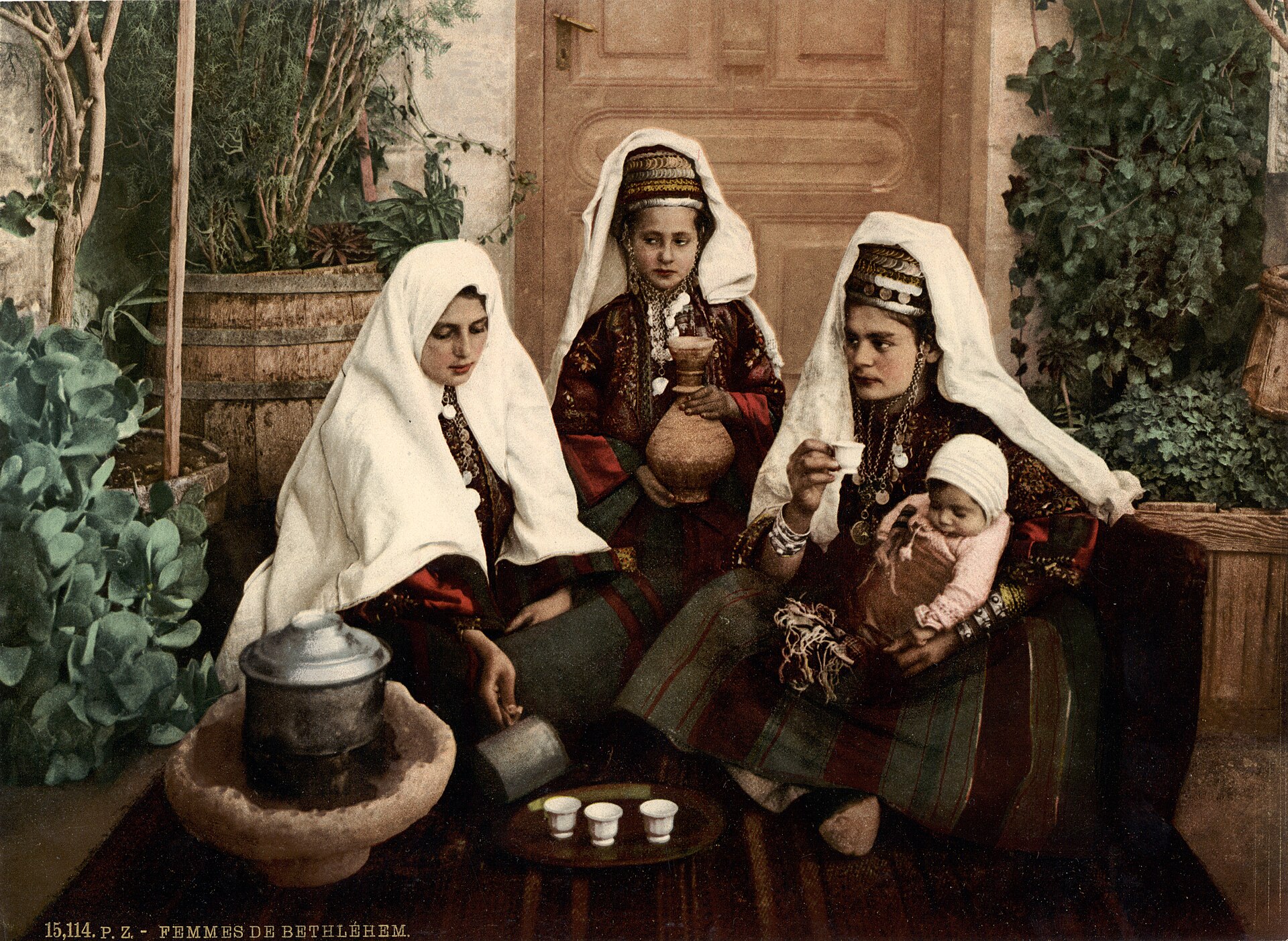
A group of Bethlehem women in traditional embroidered dress and headdresses, hand-colored photograph from about 1895
Women of Bethlehem, c. 1895, in the embroidered dress of their town. Photochrom, Library of Congress.

Church and hometown

Persians, Greeks, Romans, Byzantines, Arab caliphs, Crusaders, Mamluks, Ottomans and the British all ruled this land. Through all of it, Christians in the Levant mostly identified by their church, their family and their hometown. The Ottomans governed them as religious communities. Modern national identities only took hold in the 20th century.

Across the Levant, Orthodox, Melkite, Maronite and Syriac Christians share much of the same inheritance from the churches of Jerusalem and Antioch: the fasts before Easter and Christmas, many of the same saints, and hymns still sung in Syriac, Greek and Arabic.

Languages

Arabic, Hebrew and Aramaic belong to the Semitic language family. Syriac is a form of Aramaic with a rich Christian literary and liturgical tradition. These related languages share features of vocabulary and grammar; “Semitic” describes their linguistic relationship, rather than a single ancestry or religion.

Aramaic, Greek and Arabic have overlapped in the life of the region’s churches. Arabic became the everyday language of many communities over centuries, while Syriac and Greek continued in worship. Today, spoken Arabic varies across North Africa, the Levant, Mesopotamia and the Gulf, and even between neighboring towns.

Families across church traditions

Marriage across Christian denominations is a familiar part of Palestinian Christian life. One family may bring together Orthodox, Catholic and Protestant traditions, with relatives attending different churches and sharing one another’s celebrations. Reporting from Jifna and Nazareth describes these marriages as common within a small, closely connected community.

For someone hoping to marry a fellow Christian and remain close to home, a small community can make restricting that choice to one denomination impractical. Emigration adds to concerns about the next generation’s future. These marriages also express affection and shared faith: they should not be understood only as a response to shrinking numbers. The Latin Patriarchate explicitly recognizes families that bring different Christian traditions together and calls for pastoral care that supports them.

Catholic News Service · May 1, 2014; Latin Patriarchate · Letter to the Diocese.

Where the alphabet came from

The alphabet was developed by Canaanite scribes and spread across the Mediterranean by the Phoenicians. The Greeks adopted it, the Etruscans and Romans took it from the Greeks, and it became the Latin alphabet English uses today. Its Aramaic branch became the Hebrew, Syriac and Arabic scripts.

The word "Bible" also traces back to Byblos, the Phoenician port that shipped papyrus to Greece.

Phoenician aleph, the ox
Greek alpha
Latin A
Phoenician bet, the house
Greek beta
Latin B

Eastward, the same aleph became א ܐ ا in Hebrew, Syriac and Arabic.

Historic churches

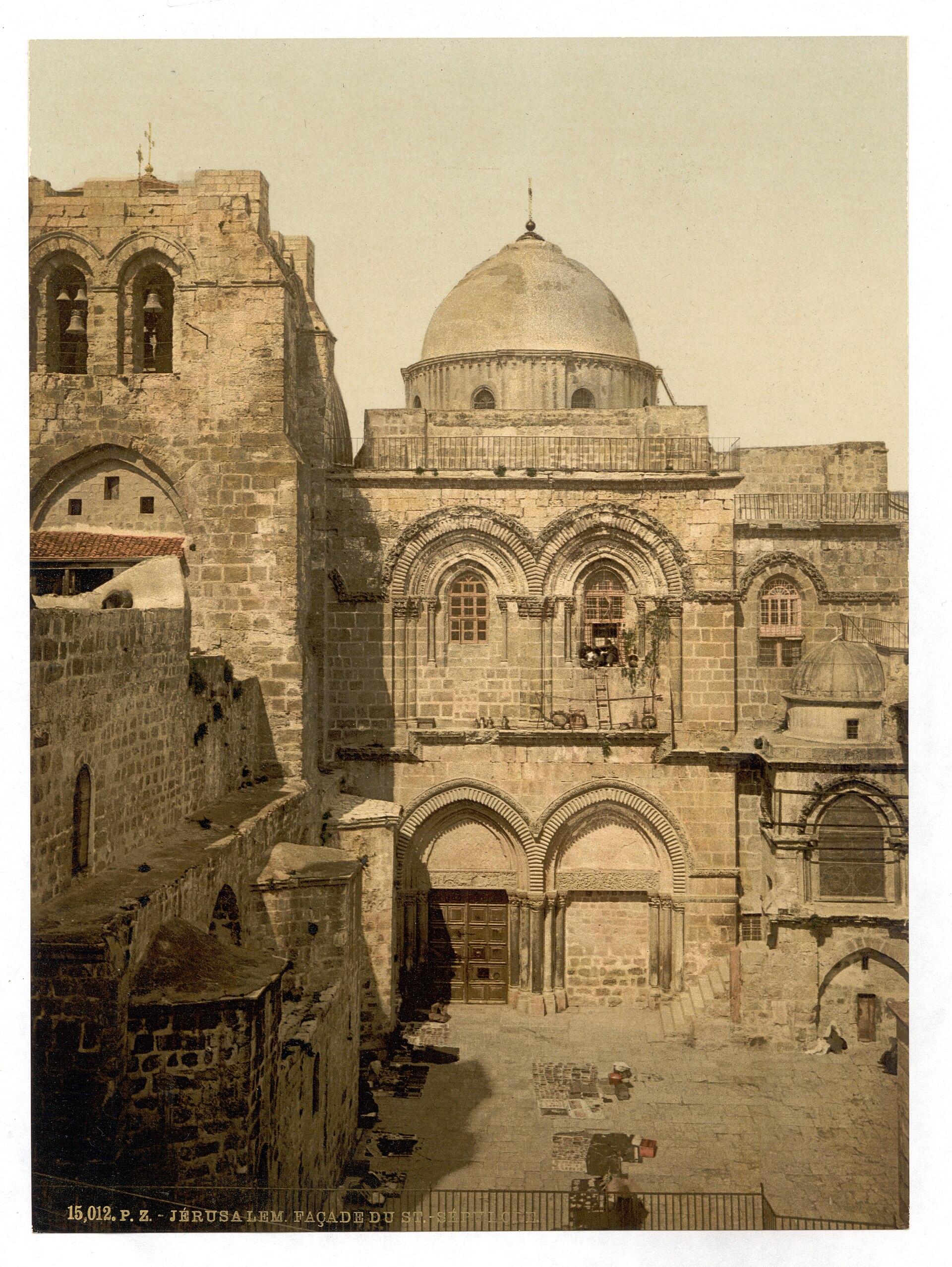
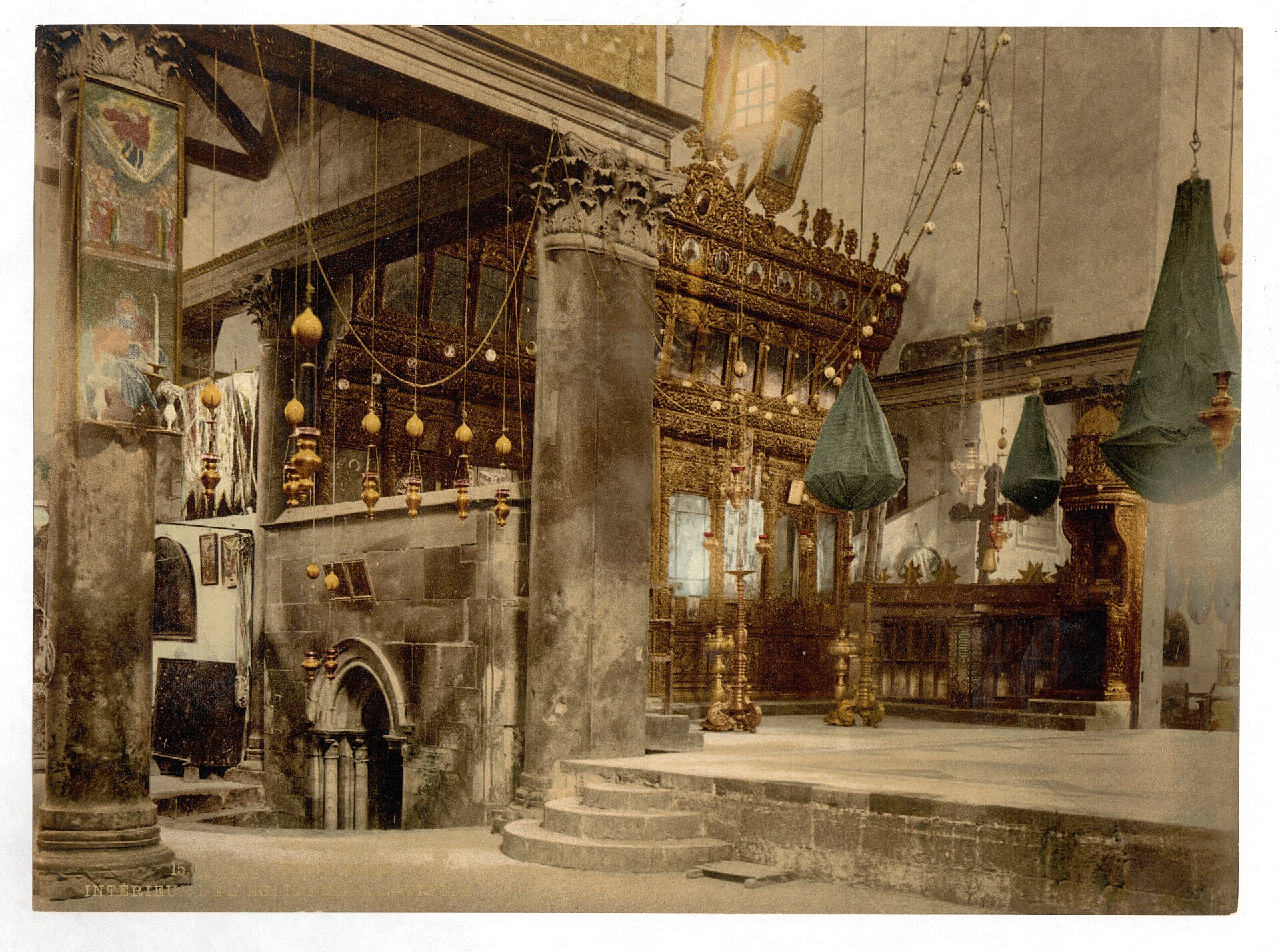
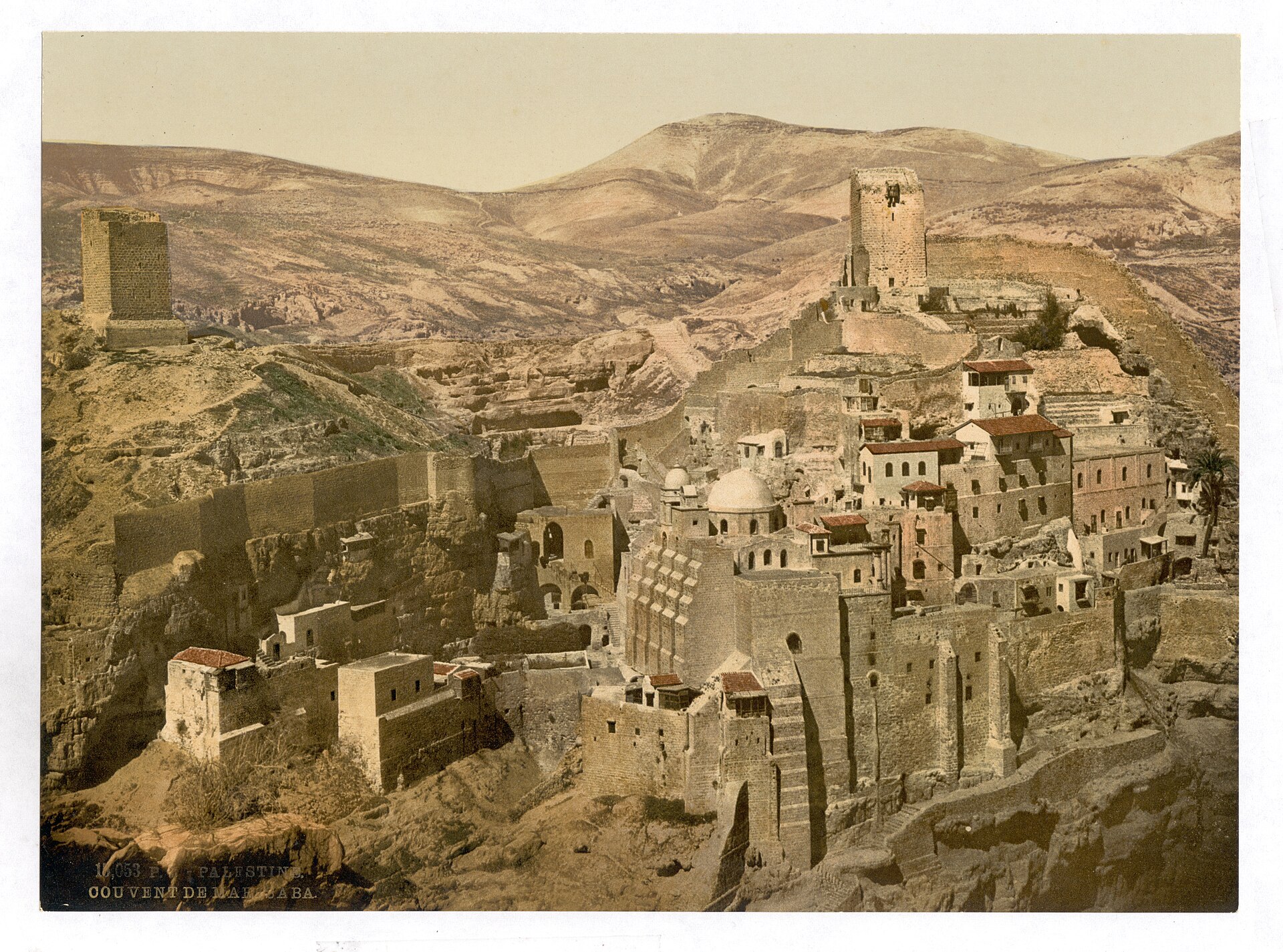
Photographs from around 1895. All four sites are still in use today.

Stone facade and courtyard of the Church of the Holy Sepulchre in Jerusalem, hand-colored photograph from the 1890s
Church of the Holy Sepulchre, Jerusalem. First built in the 4th century over the site of the crucifixion and tomb. Shared today by six ancient churches.
Columned nave of the Church of the Nativity in Bethlehem, hand-colored photograph from the 1890s
Church of the Nativity, Bethlehem. The nave dates to the 6th century and has held services without interruption since.
Mar Saba monastery built into the cliffs of the Kidron Valley, hand-colored photograph from the 1890s
Mar Saba, Kidron Valley. Founded by St. Sabbas in 483 and inhabited almost continuously since.
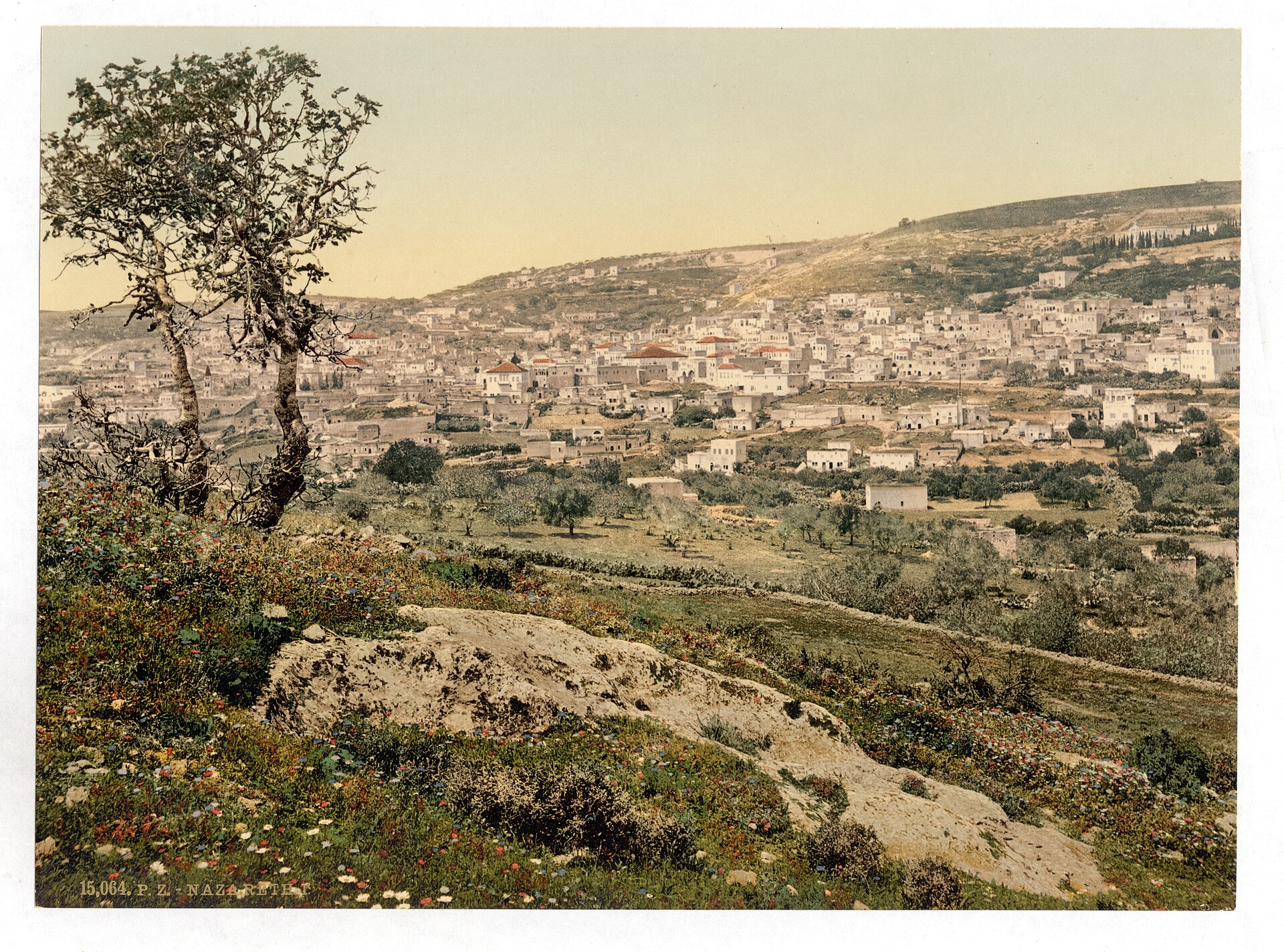
Hillside town of Nazareth seen from the east, hand-colored photograph from the 1890s
Nazareth, Galilee. The town where Jesus grew up, and still home to one of the largest Arab Christian communities in the land.

The community in figures

The census count and the record of settler attacks below cover different populations and periods.

46,850

Christians recorded in the Palestinian census of 2017.

2017 census, cited by PCPSR
275 communities

Palestinian communities affected by recorded settler attacks in 2026 through September 14. This includes communities of different faiths.

OCHA · September 18, 2026

Land and livelihoods

Bethlehem needs room to live

A community’s future depends on land for homes, access to work and the freedom to reach its schools, churches and neighbors. Around Bethlehem, land expropriation, settlement expansion and military restrictions have narrowed those possibilities for Christian and Muslim families alike.

OCHA’s 2009 study of Bethlehem documented how these measures restricted housing and economic development and weakened the city’s connections with Jerusalem.

Cremisan: separated from the land

In the Cremisan Valley beside Beit Jala, Christian families have fought to retain access to farmland passed down through generations. Catholic bishops raised the threat to their land and livelihoods in 2014. When barrier construction resumed in 2015, OCHA documented the uprooting of olive trees on a local family’s land.

The Holy Land Co-ordination reports that the wall restricts access to farmland, church buildings and the local school. The damage reaches beyond the strip of ground beneath the barrier: families can retain ownership yet lose the ability to use their land freely.

US Catholic bishops · January 2014; OCHA · Beit Jala, 2015; Holy Land Co-ordination

Jabal Abu Ghneim and Har Homa

At Jabal Abu Ghneim, Israel expropriated land from Palestinian and Jewish owners for the Har Homa project. Contemporary reporting.

The decision to build the settlement in 1997 prompted international condemnation. It became part of the settlement belt between Bethlehem and East Jerusalem. Cremisan and Jabal Abu Ghneim involve different land measures, but illustrate a recurring consequence: less land and freedom of movement for nearby Palestinian communities.

OCHA has documented how settlement expansion and planning restrictions around Bethlehem reduce space for housing, services and livelihoods. This gives the question of control a practical meaning: who can build, cultivate land and move between towns.

UN Yearbook · 1997; OCHA · Bethlehem fragmentation and humanitarian concerns, 2015

Daily life through checkpoints

Military checkpoints, road gates and closures make ordinary journeys dependent on access decisions outside residents’ control. OCHA documents the resulting disruption to work, healthcare, education and family life across the West Bank.

In September 2025, OCHA reported five newly installed road gates in Bethlehem governorate, including three in Beit Jala and Beit Sahour. Those gates were open when reported, but could cut important routes if closed. Other main entrances to Nahhalin and Wadi Fukin had already been closed since October 2023.

OCHA · September 18, 2025

When the pilgrims stopped coming

The war that began in October 2023 devastated Bethlehem’s visitor economy. In December 2024, AP reported that tourism accounted for about 70% of the city’s annual income. Citing the Palestinian tourism ministry, it reported fewer than 100,000 visitors that year, compared with roughly two million in 2019.

The loss reaches hotels, guides, restaurants, shops and the families who carve olive wood. In April 2025, AP found workshops still struggling through a second Easter without their usual visitors. One carver had reduced his workforce from 25 people to ten, working only two days a week.

AP · December 2024; AP · April 2025

Questions about Palestinian Christians

“Palestinian means Muslim.”

Palestinian identity includes Christians as well as Muslims. Their congregations include families, teachers, shopkeepers and craftspeople.

“Christian life belongs only to the past.”

Local congregations continue to worship, raise children and serve their communities. The question is whether another generation will be able to make a life at home.

“Muslim neighbors explain the Christian exodus.”

The 2020 Christian survey does not support that single-cause explanation. It documents economic, political and security pressures, alongside varied experiences of interreligious relations. Read the research.

“Criticizing Israeli policy means blaming Jewish people.”

Our criticism concerns documented conduct and the institutions responsible for it. Jewish people are not collectively responsible for a government's or a settler's actions. Palestinian freedom and Jewish safety both belong in a just peace.

“A community abroad no longer needs its homeland.”

A family can build a life elsewhere and still cherish its ancestral home. We welcome the diaspora as part of this living community, while supporting those who wish to remain.

Our position

Against hatred and supremacy

We reject religious and ethnic supremacy, the celebration of violence, and any claim that ancestry or belief makes one person's life more valuable than another's. This standard applies to extremists of every religion and to secular movements alike.

Judaism and the Israeli state

The Israeli state and Judaism are not interchangeable. A government cannot speak for every Jewish person; its conduct cannot make Jewish neighbors responsible for its actions. Criticism of state policy must never become antisemitism. The same protection against collective blame belongs to Palestinians, Muslims and Christians.

Incitement in public office

On June 10, 2025, the UK, alongside Australia, Canada, New Zealand and Norway, announced sanctions against Itamar Ben-Gvir and Bezalel Smotrich over incitement to extremist violence and abuses against Palestinians. These were targeted sanctions against individuals, not a criminal genocide judgment.

UK government announcement · June 10, 2025

The celebration of extremists

At Goldstein’s funeral in February 1994, Rabbi Yaacov Perrin said a million Arabs “are not worth a Jewish fingernail.” Contemporary reporting.

Goldstein had massacred Muslim worshippers in Hebron’s Ibrahimi Mosque. Praising the killer while dismissing the worth of his victims is an example of the supremacy we condemn. Background on the massacre.

In November 2022, Ben-Gvir attended a memorial for Meir Kahane and praised elements of his legacy. He also said he did not support expelling all Arabs, drawing boos from the audience. His praise for Kahane deserves scrutiny, including when he holds public office.

The Times of Israel · November 10, 2022

The UN commission’s genocide finding

On September 16, 2025, the UN Independent International Commission of Inquiry concluded that Israel had committed genocide against Palestinians in Gaza. This is a finding by UN investigators, distinct from a criminal conviction of a named individual.

The ICJ's January 26, 2024 provisional order required Israel to prevent prohibited acts and prevent and punish direct, public incitement to genocide. That interim order did not decide the case's merits.

UN commission announcement · ICJ order, January 26, 2024

Legal accountability

We call for independent investigation and prosecution of officials and others responsible for atrocities, with evidence tested through fair legal proceedings and lawful arrest warrants enforced. Neither elected office nor religious identity should shelter anyone from accountability.

Opposing prejudice

We condemn attacks on civilians, incitement, antisemitism, anti-Muslim hatred and the dehumanization of Palestinians. No government's actions justify hostility toward Jewish people anywhere. No atrocity against one community excuses an atrocity against another.

The warning from Nazi Germany

The United States Holocaust Memorial Museum documents how Nazi propaganda spread antisemitism, helped normalize exclusion, and secured acceptance of persecution and mass murder. Nazi Germany and its allies and collaborators murdered six million Jews in the Holocaust and persecuted other targeted groups.

That history demands vigilance when leaders rank human lives, turn whole populations into enemies, celebrate violent movements or dismantle protections against persecution. These are patterns to examine through evidence, without erasing the Holocaust's distinct history or assigning Nazi guilt to an entire people today.

We have a responsibility to challenge dehumanization before it becomes accepted public policy, and to protect the people it puts at risk. USHMM: Nazi propaganda · USHMM: the people the Nazis targeted.

Our Christian faith

We believe in Jesus Christ and his command to love our neighbors. Scripture calls us to make peace, care for those in need and live our faith with humility.

Dona nobis pacem.

Grant us peace.

These words close the Agnus Dei, the Lamb of God prayer in the Roman Mass. We pray for that peace in the homes, churches and streets of the Holy Land.

General Instruction of the Roman Missal · §83

Our name and our star

Shepherd Us is a prayer for the Lord to guide us. “The Lord is my shepherd,” begins Psalm 23. In John’s Gospel, Jesus calls himself the good shepherd. We seek to follow him through compassion and practical care for our brothers and sisters.

Our logo is the Star of Bethlehem. We also remember the shepherds keeping watch over their flocks on the night Jesus was born. In Luke’s Gospel, an angel brings them the news, and they hurry to Bethlehem, where they find Mary, Joseph and the child lying in a manger.

Matthew tells of the star that guided the Magi to Jesus. Together, the star and the shepherds recall the joy of his birth and the town where it happened. Bethlehem is still home to Christian families, and their future matters to us.

Psalm 23:1 · John 10:11 · Luke 2:8–16 · Matthew 2:1–11

“And if ye be Christ's, then are ye Abraham's seed, and heirs according to the promise.”
Galatians 3:29 · KJV

In Galatians 3:26–29, Paul describes belonging to God's family through faith in Christ, across the distinction between Jew and Greek. We affirm that welcome to people of every ancestry.

“Boast not against the branches.”
Romans 11:18 · KJV

Paul also warns Gentile believers against arrogance and affirms God's enduring calling in Romans 11:29. Christians interpret the covenant differently; these texts must not be used to demean Jewish people.

What we fund

Our programs target the practical reasons families leave. Grants go to local churches and community organizations we have vetted. None go to any government or armed group.

  • Housing and legal aid

    Legal help defending property titles and residency rights, and repair grants for homes families would otherwise abandon.

  • Artisans and small business

    Orders placed directly with Bethlehem's olive-wood and mother-of-pearl workshops, and small grants to reopen shuttered family businesses.

  • School tuition

    Tuition support at church-run schools, which educate Christian and Muslim children side by side and anchor families to their towns.

  • Church restoration

    Restoration of historic churches, cemeteries and village heritage sites, done by local craftsmen.

  • Emergency relief

    Emergency food, medicine and shelter in Gaza and the West Bank, delivered through the local patriarchates and parishes.

Every grant we make is listed in our annual report with the recipient and amount.

Give

Online giving is not open yet. Explore the areas you would like to support as we prepare to receive gifts.

For future giving opportunities, visit our contact and updates section.

How often
Amount

This website does not currently accept payments. Legal status and tax information will be published before giving opens.

Keep in touch

Receive news from the foundation, or contact us about getting involved.

The Shepherd Us newsletter

Ask about our work and choose whether you would like email updates.

Online requests are not open yet. Please check back soon.

Contact the foundation

Get in touch about volunteering, giving or working together. Only your name and email are required.

Online requests are not open yet. Please check back soon.

We use your details to respond to your request. Email marketing is optional and requires your opt-in. Please do not include sensitive personal or payment information.